














A five-part briefing based on Harvard Business School’s ‘Cold Call’ case discussion with Professor Caroline Elkins, re-read for Indian boardrooms, newsrooms and creators.
Part 1: The Deal That Split a Newsroom
In March 2024, The Atlantic — one of America’s oldest literary magazines — signed a content-licensing deal with OpenAI. OpenAI got to train its models on the magazine’s archive and serve its content inside ChatGPT. The Atlantic got an undisclosed fee, early access to OpenAI’s tools, and ‘premium’ placement. Over 70 publishers had already done similar deals. The New York Times, meanwhile, was suing OpenAI for allegedly lifting 16 million copyrighted articles without permission.
Inside The Atlantic, journalists called it ‘a devil’s bargain.’ Outside, owner Laurene Powell Jobs, the billionaire behind the Emerson Collective, was betting on something bigger: that AI needs great human writing more than great human writers need AI, and that the winners of the next decade will be the ones who figure out that trade before it’s forced on them.
Harvard Business School professor Caroline Elkins, who wrote the case, frames it through a simple supply chain: idea → meaning → scale → value. AI can scale content instantly. What it still can’t manufacture is meaning – the interpretation, context and trust that turns a raw idea into something worth paying for. Powell Jobs’s bet is that this missing middle step is where the money will live.
Why this matters in India
Swap ‘The Atlantic vs. OpenAI’ for ‘ANI vs. OpenAI’ and you have the same fight playing out in Delhi High Court right now. In November 2024, the news agency Asian News International sued OpenAI, alleging ChatGPT was trained on its copyrighted wire content without a licence or payment. This was India’s first generative-AI copyright suit.
ANI claims ChatGPT illegally scraped its freely available and paywalled content, and is seeking roughly ₹2 crore in damages plus an injunction against further use. The Federation of Indian Publishers, along with music and film bodies – the Indian Music Industry, T-Series and Saregama – have all moved to intervene, arguing the outcome will ripple far beyond one news agency; the court itself has noted that hundreds of industries could be affected.
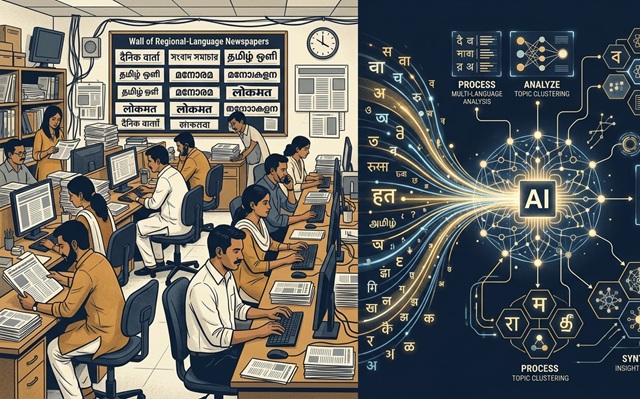
OpenAI’s own defence has echoed the ‘we send you traffic’ line publishers hear everywhere, arguing ChatGPT drives readers to ANI rather than competing with it. Whichever way this goes, Indian publishers from The Print to Network18 to regional-language giants like Dainik Bhaskar and Malayala Manorama are watching it as their own S-curve decision point: license and get paid, sue and hold the line, or wait and risk both.
 Part 2: India’s Own Creativity Crisis — and Why It’s Different
Elkins points to a striking data point: a 300,000-subject study of the Torrance Tests of Creative Thinking found American creativity scores rising steadily from the 1950s through the 1990s, and then declining ever since. Her question: is AI going to accelerate that decline, or reverse it?
India’s version of this anxiety looks different but is arguably sharper. The country’s education system built for scale, not divergence, has long been criticised for rewarding memorisation over original thought; NEP 2020’s push toward ‘experiential and holistic’ learning is itself an admission of the problem.
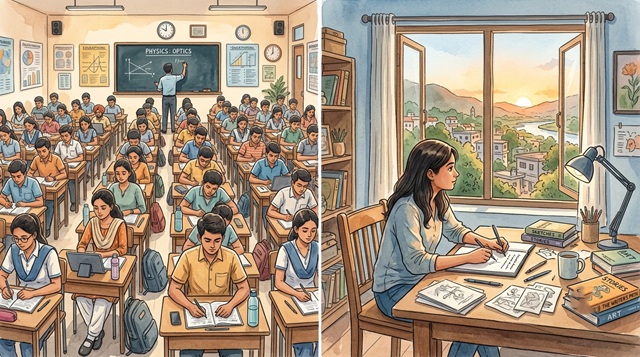
Now overlay AI on top of a system already tuned for rote answers: coaching-factory towns like Kota, where lakhs of students train for JEE and NEET through repetition drilling, are exactly the environment where a chatbot that writes the ‘correct’ essay or solves the ‘correct’ problem could either be a crutch that flattens thinking further, or, if used well, free up mental bandwidth for the harder, messier work of original ideas.
Elkins’s read on the global evidence is nuanced, not doom-laden: AI raises the floor for people with lower baseline creativity, but highly creative people still consistently out-perform it. Applied to India, that suggests the real risk isn’t ‘AI replacing Indian creators?’ It’s a widening gap between a small number of people who learn to direct AI toward genuinely original work, and a much larger group who use it to produce more of the same, faster.
An Indian marker worth watching
India already produces more IITians, CA aspirants and engineers per capita than almost anywhere. It is a system optimised for efficiency and correctness. The country’s cultural and creative output that may be said to be Hindi cinema, OTT storytelling, stand-up comedy, indie music, regional literature, has historically come from outside that system, or from people who deliberately stepped off it.
The same risk Elkins flags for the US applies to India, maybe more so. If AI becomes just another tool for getting ‘efficient’ answers faster, in schools and workplaces alike, it leaves less time and space for real creative thinking. And Indian institutions are already built around efficiency, so this problem could be worse here, not better.
Part 3: The Business of Ideas, Bollywood Edition
Elkins’s ‘idea → meaning → scale → value’ framework was built for magazine journalism, but it maps almost perfectly onto Indian entertainment and content businesses right now.
Take AI-generated voice and likeness in Hindi cinema. In 2023, actor Anil Kapoor won a landmark Delhi High Court order protecting his name, voice, image and even his catchphrases from unauthorised AI use. This was one of the first personality-rights rulings of its kind in India, well ahead of similar Hollywood fights over AI likeness. That’s the ‘idea’ layer being fenced off by law before the market could fully commoditise it.
Take podcasting, which Elkins holds up as the antidote to AI-generated ‘content exhaust’ – 30 minutes of a real, informed voice instead of infinite scroll. India’s fastest-growing media format right now is exactly that: Nikhil Kamath’s WTF is has pulled in Prime Ministers and Nobel laureates for long-form conversation; Raj Shamani, Ranveer Allahbadia (BeerBiceps) and regional equivalents in Tamil, Telugu and Bengali have built audiences precisely because a listener trusts a specific human voice to interpret a topic — the ‘meaning’ layer Elkins says AI can’t replicate.
Take news wire economics. PTI, IANS, UNI, ANI’s entire business model is licensing content to hundreds of downstream publishers — structurally, they are already in the business Powell Jobs is trying to invent for The Atlantic: getting paid for being the trusted upstream source. The AI licensing question isn’t new for them; it’s the same business model with a new buyer.
And take Krutrim, Sarvam AI and Bhashini which are India’s push to build sovereign, Indian-language large language models. Elkins’s line that “if you keep feeding a model the same stuff, it collapses” applies directly here: Indian LLMs need fresh, high-quality Hindi, Tamil, Bengali, Marathi and other regional-language material to be genuinely useful. This means Indian regional publishers and writers are sitting on exactly the kind of scarce, high-value training data global players like OpenAI are also short of. That’s real, near-term negotiating leverage for Indian content owners, if they choose to use it collectively rather than one deal at a time.

Part 4: The Age of Efficiency vs. the Age of Creativity — an Indian Workplace Read
Elkins argues we’re exiting a century-long ‘age of efficiency’ (she traces it to Frederick Taylor’s scientific management, the same doctrine Harvard Business School itself was founded on) and entering an ‘age of creativity.’ Her sharpest data point: a Microsoft survey of 30,000 companies found two-thirds of CEOs worried most about where the next big idea will come from. Most of them planned to reinvest AI efficiency gains straight back into more efficiency (more KPIs), not more time for people to think.
That tension is acute in Indian corporate culture, where efficiency, output and bandwidth are practically religious values. IT services, India’s largest white-collar employer, is built entirely on the efficiency logic: billable hours, utilisation rates, SLA metrics.
As GenAI tools like GitHub Copilot and internal copilots at TCS, Infosys and Wipro compress coding and documentation time, the Microsoft CEOs’ dilemma becomes India’s dilemma at industrial scale: will freed-up hours become slack for engineers to build something original, or simply get reabsorbed into higher utilisation targets and leaner headcount?
Elkins cites creativity researcher Teresa Amabile’s finding that time pressure is ‘kryptonite’ to creative thinking. Indian startups already run on some of the highest work-intensity norms globally. The 996-adjacent debates sparked by comments from Indian founders about 70-hour work weeks are a live version of this exact argument. If Elkins is right that AI-era winners will be organisations patient enough to let people think, the way Powell Jobs is patient with her long-form writers, that’s a direct challenge to a founder culture that often prizes hustle over headspace.

Part 5: A Playbook for Indian Leaders, Publishers and Creators
Drawing directly from Elkins’s analysis, here is what her framework implies for Indian decision-makers:
1. Decide your posture before AI decides it for you. Elkins’s blunt question to her MBA students – “Do you partner with OpenAI or do you sue them?” is exactly the choice facing ANI, IANS, UNI, PTI, and every regional publisher watching the Delhi High Court case. There is no neutral third option; delay is itself a choice, and it’s usually the worst one.
2. Protect the ‘meaning’ layer, not just the raw content. Wire copy and news alerts may well become commoditised by AI, the way Elkins expects generic news copy to be. What Indian publishers can defend, through law, brand and talent investment, is long-form interpretation, investigative reporting and trusted regional-language commentary, the layer AI still can’t produce.
3. Use India’s language advantage as leverage, not just a compliance problem. Sovereign LLM builders need fresh Hindi, Tamil, Bengali, Marathi and other regional content badly. Indian publishers and creators should treat this as a negotiating chip for licensing deals, not merely a copyright dispute to be litigated defensively.
4. Get ahead on personality and IP rights. The Anil Kapoor ruling shows Indian courts are willing to move fast on AI-likeness protection. Actors, voice artists, writers and influencers should register and assert these rights now, before scale makes enforcement harder.
5. Reinvest efficiency gains in time, not just throughput. Amabile’s research says creativity needs slack, not more KPIs. Indian firms adopting AI copilots should treat the hours saved as a deliberate reinvestment question, more thinking time for the best people, not an automatic headcount or utilisation lever.
6. Bet on your most creative people, and pay them like it. Powell Jobs is paying her best long-form writers well above industry standard, precisely because true creativity remains scarce and AI-resistant. Indian organisations, from newsrooms to studios to startups, will increasingly separate into those who understand this and those still trying to out-efficiency a wave that rewards the opposite.
One line to remember
AI will not decide whether India enters an age of creativity. That will be decided by whether Indian institutions, like courts, newsrooms, studios, and companies protect and reward the slow, expensive, human middle step between an idea and its scale: meaning.
Based on: “Are We Entering a New Age of Creativity with the Help of AI?”, HBR Cold Call podcast, July 2026, featuring Harvard Business School professor Caroline Elkins in conversation with host Brian Kenny.