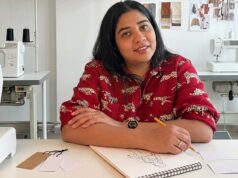














Q1. You studied Business Administration before switching to fashion design. That is not a small decision. What made you take that leap?
During campus placements, I realised I was on a path that would have me building someone else’s dream. And I just couldn’t settle for that. I had always been creative – that was never in doubt. But it was in that moment, when everyone around me was chasing placement offers, that I understood I wanted to build my own identity through something I genuinely enjoy. Creativity is not just a hobby for me. It is how I think. Switching to fashion design was a risk, yes. But it was the most honest decision I have ever made.
Q2. You worked at export houses supplying international brands before launching YOGYA. What did those years teach you that no classroom could?
They taught me the reality of garment construction. When you are in an export house, you understand exactly how a garment is built – the process, the detailing, what holds, what doesn’t, where shortcuts are taken and what they cost. I was working on pieces destined for international labels, and the standards were rigorous. That experience gave me a very clear picture of the gap between what gets mass-produced and what a woman actually wants to wear. I carried that knowledge directly into how I approach YOGYA’s design process.
Q3. YOGYA offers sizing from XS to 10XL. In India’s fashion market, that is still rare. Why was inclusivity a non-negotiable from day one?
Because fashion has spent far too long telling women to fit the clothes. I wanted to turn that around completely. When I design, I am thinking about real women – different bodies, different proportions, different lives. Offering sizes up to 10XL is not a marketing strategy for me. It is a design responsibility. Every woman deserves to wear something beautiful and feel worthy in it. That is literally what the brand name means. I cannot claim that philosophy and then exclude half my audience through sizing.
Q4. Your tagline is ‘Feel your worth in every outfit.’ How does that translate into actual design decisions?
It means I never design for the mannequin. A piece has to work on a body that moves, sits, dances, leans across a table at dinner. Comfort is not the opposite of elegance – it is what makes elegance sustainable. So every design decision I make, be it the cut, the fabric, the fit, the construction, it is tested against one question: will the woman wearing this feel like herself, or will she be managing the outfit all evening? If it is the latter, I go back to the drawing board.
Q5. You named the brand after yourself. That is a significant act of ownership. Did you hesitate?
Honestly, no. And that surprised me too. But when I thought about what I was building, it made complete sense. YOGYA the word means worthy, capable, deserving. That is the feeling I want to give my customers. And by attaching my own name to it, I am telling every customer: there is a real person here who cares about what you receive. This is not a faceless corporation. Every piece that goes out carries my name quite literally. That is accountability in the most personal form possible.
Q6. You have been backstage at Lakme Fashion Week for two seasons. What did that experience change for you?
Everything, in terms of perspective. Being backstage is not glamorous. It is organised chaos, last-minute decisions, the gap between what is imagined and what actually makes it to the runway. But it gave me something invaluable: a real, unfiltered understanding of how the industry works. I saw what went into building a show, how designers handled pressure, where effort pays off and where it gets lost. When I came away from those seasons, I had a much clearer sense of what I wanted to do differently, and why.
Q7. Where do you see YOGYA in five years?
I see a brand that is widely recognised, not because it chased trends, but because it stayed true to its philosophy. I want a physical studio where customers can walk in, experience the collections, and be a part of the YOGYA world in a way that a screen cannot fully deliver. I also want to expand into footwear and accessories, but only once the clothing is exactly where I want it to be. The foundation has to be unshakeable first. Then the rest of the universe can follow.
Q8. What would you say to a young woman who wants to start her own label but is waiting for the right moment?
The right moment does not arrive. You create it. I come from a small town. I switched careers after graduation. I did not have a famous mentor or a big investment. What I had was clarity about what I wanted to make, and the willingness to start before I felt ready. The fashion industry is crowded but it always has room for something genuine. Build with intention. Be patient with the process. And remember: the word yogya does not just describe my brand. It describes you too.
You may like reading this too: She Named the Brand After Herself — Because the Word Means ‘Worthy’