














Romantic comedies often promise that love is simply waiting around the next corner. Materialists suggests something far more unsettling. Love may already be standing in front of us. We simply keep looking elsewhere because certainty appears more attractive than vulnerability.
Set against the restless energy of New York City, Materialists follows Lucy, a successful matchmaker who has turned romance into a profession. Every introduction is carefully calculated. Every relationship is assessed like an investment. Compatibility is measured, lifestyles compared and futures predicted. Love, in Lucy’s world, has become a science.
Suddenly, Lucy is herself caught between two very different men. While Harry appears to be everything modern dating celebrates, John’s life is far less polished but whose feelings remain profoundly uncomplicated.
But the film never asks which man is better. It asks which relationship is more truthful.
One of the film’s most memorable moments comes when John tells Lucy, how hard it is to try to make her happy. It is a line that carries frustration, affection and acceptance in equal measure. Loving someone, the film reminds us, is not always easy. Sometimes the greatest act of love is staying despite the difficulty.
Later, when Lucy insists that she can take care of herself, John gently shifts the conversation. He tells her that wanting to build a life together is what makes him brave enough to admit that he wants happiness, and that he wants that happiness with her. That exchange quietly becomes the emotional centre of the film.
The screenplay, filled with sharp dialogue, saves its finest moment for the conversation that follows. John tells Lucy he has been doing some maths before making what he calls his final offer. He promises to love her for the rest of his life, even when life becomes difficult. He jokes that he will set a daily calendar reminder so he never forgets what truly matters. He offers certainty, not perfection.
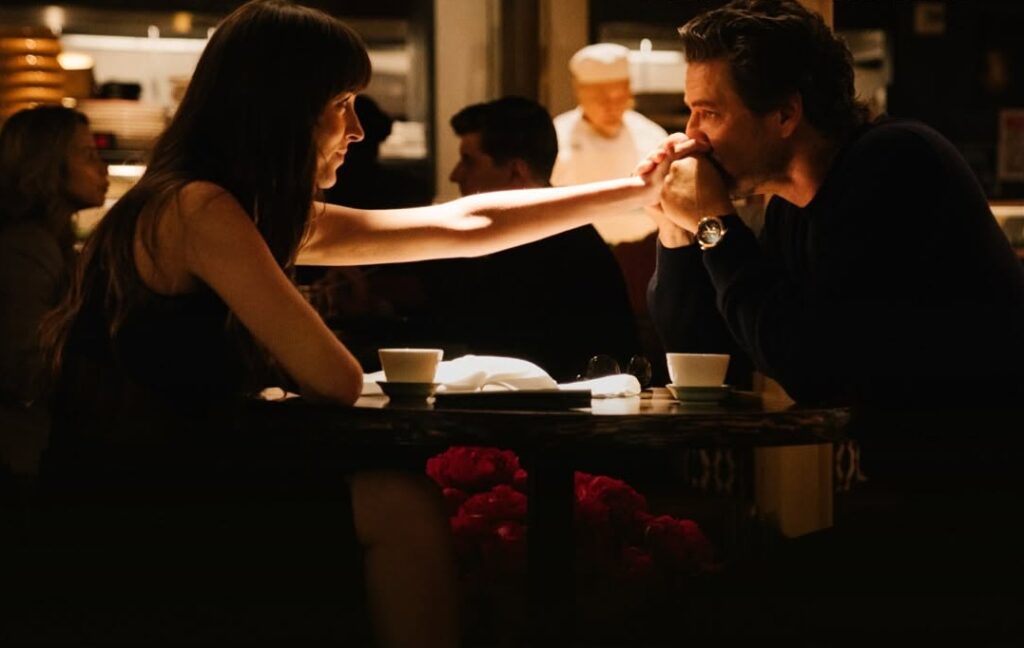
The film is equally perceptive in its conversations between Lucy and Harry. At one point, Lucy tells him she does not like him because he is rich. When Harry asks why she likes him, she replies that he makes her feel valuable. His response is immediate: “You are valuable.”
Those few words capture the emotional conflict at the heart of Materialists. Are we searching for someone who validates our worth, or someone who simply recognises it?
Watch the film to discover Lucy’s choice. Does she say Deal to a lifetime guarantee of love, or choose Harry’s diamond ring and the promise of a picture-perfect future in Iceland? You will find this movie as one of the most quietly moving romantic scenes in recent memory.
Dakota Johnson delivers one of her most restrained performances, allowing Lucy’s uncertainty to unfold through silence as much as dialogue. Chris Evans brings remarkable warmth to John, making him impossible not to root for. Pedro Pascal gives Harry dignity and emotional intelligence, resisting the temptation to become the convenient rival.
That balance is what elevates the film. Nobody is reduced to a stereotype. Every character has emotional legitimacy. May be therefore the film ultimately leaves viewers with perhaps its most important observation.
Who our partner is determines our whole life, and how we live it. Not for a year or two, but for decades. It is a reminder that choosing a life partner is perhaps the most consequential decision we ever make. Careers change. Cities change. Fortunes rise and fall. But the person who walks beside us shapes almost every version of our future.
Materialists is not merely about dating. It is about self-worth, emotional courage and the quiet promises that sustain a lifetime.
Most importantly, it understands something many films forget. The greatest love stories are not built on perfect matches. They are built on imperfect people who decide, every single day, to choose each other anyway.
This is a film every couple should watch together. Not because it tells them how to love, but because it gently asks whether they are choosing each other every day, long after the excitement of being chosen has faded.
That question lingers well after the credits roll.